
From simulation to reality: MSU-Meridian students train for childbirth
Contact: Marianne Todd
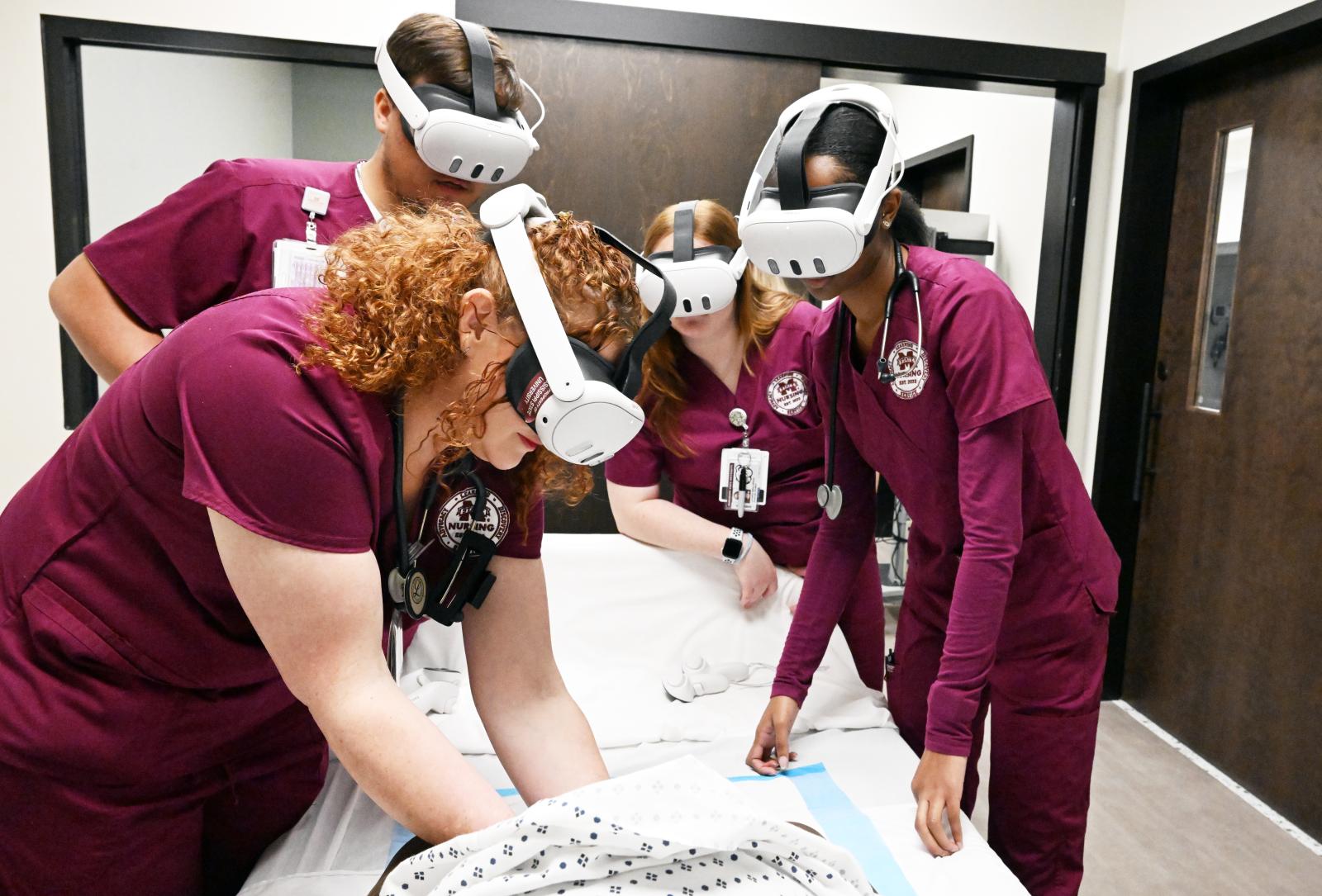
MERIDIAN, Miss.—Before beginning their labor and delivery clinicals this month, Mississippi State University-Meridian Master of Science in Nursing students are stepping virtually into the delivery room to simulate their first live birth.
“They’re told before they begin what will happen, but they don’t realize how lifelike it will be,” said Alaina Herrington, director of simulation and clinical affairs. “It’s a very customized AI that talks back and forth with students, and it responds immediately.”
The simulation coincides with the program’s spring training in obstetrics and labor and delivery, preparing nursing students to possibly experience delivery of live births during their clinical rotations.
Herrington said the hybrid mixed reality technology that utilizes an oculus is a costly simulation and one in which students generally incur fees.
“But this one is free to our students,” she said. “This assists them in deciding if they want to go into obstetrics or not.”
MSN student Melony Robinson of Jackson said prior to the experience she had never seen a birth.
“I wasn’t expecting it to be so vivid,” Robinson said. “We walked the patient through contractions and pushing. It felt so real.”
Valerie Nicholson, assistant director of simulation, said virtual experience offers a more dynamic simulation by allowing students to engage in lifelike scenarios in real time.
“It hits on all the sensory perceptions,” she said, adding that the avatar can readily respond to student nurses’ commands. “You can interact with the avatar, and she will respond accordingly.”
The labor and delivery simulation followed March’s sepsis protocol simulation in which students walked a critically ill patient through emergency room admission, intensive care unit treatment and finally discharge.
For this simulation, social work students from the Starkville campus joined Meridian’s MSN and Master of Physician Assistant Studies students to explore social determinants.
“In this case, there was a brother caring for his sister, but they didn’t have the economical resources they needed,” Herrington said. “They had no travel accommodations and no insurance, and so, the team had to figure out how to provide patient care.”
Building such determinants into simulation constructs is invaluable in real life scenarios, Herrington said.
“They learn from the book, but in reality, you must make the care customized to your patient,” Herrington said.
Nicholson said the students find joy in simulations, cheering after assisting with births.
“There’s nothing like being there for those moments,” she said. “Having this experience will make them better practitioners.”
Mississippi State University is taking care of what matters. Learn more at www.msstate.edu.